
Ecology (from Greek: οἶκος, "house" or "living relations"; -λογία, "study of") is the scientific study of the distributions, abundance and relations of organisms and their interactions with the environment. Ecology includes the study of plant and animal populations, plant and animal communities and ecosystems. Ecosystems describe the web or network of relations among organisms at different scales of organization. Since ecology refers to any form of biodiversity, ecologists research everything from tiny bacteria's role in nutrient recycling to the effects of tropical rain forest on the Earth's atmosphere. The discipline of ecology emerged from the natural sciences in the late 19th century. Ecology is not synonymous with environment, environmentalism, or environmental science. Ecology is closely related to the disciplines of physiology, evolution, genetics and behavior.
Like many of the natural sciences, a conceptual understanding of ecology is found in the broader details of study, including:
* life processes explaining adaptations
* distribution and abundance of organisms
* the movement of materials and energy through living communities
* the successional development of ecosystems, and
* the abundance and distribution of biodiversity in context of the environment.
Ecology is distinguished from natural history, which deals primarily with the descriptive study of organisms. It is a sub-discipline of biology, which is the study of life.
There are many practical applications of ecology in conservation biology, wetland management, natural resource management (agriculture, forestry, fisheries), city planning (urban ecology), community health, economics, basic & applied science and it provides a conceptual framework for understanding and researching human social interaction (human ecology).
All organisms are motile to some extent. Even plants express complex behavior, including memory and communication. Behavioural ecology is the study of ethology and its ecological and evolutionary implications. Ethology is the study of observable movement or behaviour in nature. This could include investigations of motile sperm of plants, mobile phytoplankton, zooplankton swimming toward the female egg, the cultivation of fungi by weevils, the mating dance of a salamander, or social gatherings of amoeba.
Adaptation is the central unifying concept in behavioral ecology."International Society for Behavioral Ecology". http://www.behavecol.com/pages/society/welcome.html. Behaviors can be recorded as traits and inherited in much the same way that eye and hair color can. Behaviours evolve and become adapted to the ecosystem because they are subject to the forces of natural selection. Hence, behaviors can be adaptive, meaning that they evolve functional utilities that increases reproductive success for the individuals that inherit such traits. This is also the technical definition for fitness in biology, which is a measure of reproductive success over successive generations.
Predator-prey interactions are an introductory concept into food-web studies as well as behavioural ecology. Prey species can exhibit different kinds of behavioural adaptations to predators, such as avoid, flee or defend. Many prey species are faced with multiple predators that differ in the degree of danger posed. To be adapted to their environment and face predatory threats, organisms must balance their energy budgets as they invest in different aspects of their life history, such as growth, feeding, mating, socializing, or modifying their habitat. Hypotheses posited in behavioural ecology are generally based on adaptive principals of conservation, optimization or efficiency.For example,
"The threat-sensitive predator avoidance hypothesis predicts that prey should assess the degree of threat posed by different predators and match their behavior according to current levels of risk."
"The optimal flight initiation distance occurs where expected postencounter fitness is maximized, which depends on the prey’s initial fitness, benefits obtainable by not fleeing, energetic escape costs, and expected fitness loss due to predation risk."
The behaviour of long-toed salamanders (Ambystoma macrodactylum) presents an example in this context. When threatened, the long-toed salamander defends itself by waving its tail and secreting a white milky fluid. The excreted fluid is distasteful, toxic and adhesive, but it is also used for nutrient and energy storage during hibernation. Hence, salamanders subjected to frequent predatory attack will be energetically compromised as they use up their energy stores.
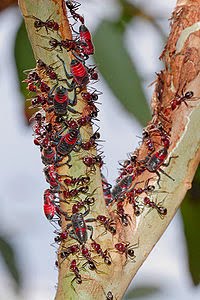
Symbiosis: Leafhoppers (Eurymela fenestrata) are protected by ants (Iridomyrmex purpureus) in a symbiotic relationship. The ants protect the leafhoppers from predators and in return the leafhoppers feeding on plants exude honeydew from their anus that provides energy and nutrients to tending ants.
Ecological interactions can be divided into host and associate relationships. A host is any entity that harbors another that is called the associate. Host and associate relationships among species that are mutually or reciprocally beneficial are called mutualisms. If the host and associate are physically connected, the relationship is called symbiosis. Approximately 60% of all plants, for example, have a symbiotic relationship with arbuscular mycorrhizal fungi. Symbiotic plants and fungi exchange carbohydrates for mineral nutrients.Symbiosis differs from indirect mutualisms where the organisms live apart. For example, tropical rainforests regulate the Earth's atmosphere. Trees living in the equatorial regions of the planet supply oxygen into the atmosphere that sustains species living in distant polar regions of the planet. This relationship is called commensalism because many other host species receive the benefits of clean air at no cost or harm to the associate tree species supplying the oxygen. The host and associate relationship is called parasitism if one species benefits while the other suffers. Competition among species or among members of the same species is defined as reciprocal antagonism, such as grasses competing for growth space.
Parasites: A harvestman arachnid is parasitized by mites. This is parasitism because the spider suffers as its juices are slowly sucked out and the mites gain all the benefits of a host to travel on and feed off.
Popular ecological study systems for mutualism include, fungus-growing ants employing agricultural symbiosis, bacteria living in the guts of insects and other organisms, the fig wasp and yucca moth pollination complex, lichens with fungi and photosynthetic algae, and corals with photosynthetic algae.
Intraspecific behaviours are notable in the social insects, slime moulds, social spiders, human society, and naked mole rats where eusocialism has evolved. Social behaviours include reciprocally beneficial behaviours among kin and nest mates.Social behaviours evolve from kin and group selection. Kin selection explains altruism through genetic relationships, whereby an altruistic behaviour leading to death is rewarded by the survival of genetic copies distributed among surviving relatives. The social insects, including ants, bees and wasps are most famously studied for this type of relationship because the male drones are clones that share the same genetic make-up as every other male in the colony. In contrast, group selectionists find examples of altruism among non-genetic relatives and explain this through selection acting on the group, whereby it becomes selectively advantageous for groups if their members express altruistic behaviours to one another. Groups that are predominantely altruists beat groups that are predominantely selfish.
A often quoted behavioural ecology hypothesis is known as Lack's brood reduction hypothesis (named after David Lack). Lack's hypothesis posits an evolutionary and ecological explanation as to why birds lay a series of eggs with an asynchronous delay leading to nestlings of mixed age and weights. According to Lack, this brood behaviour is an ecological insurance that allows the larger birds to survive in poor years and all birds to survive when food is plentiful.
Elaborate sexual displays and posturing are encountered in the behavioural ecology of animals. The birds of paradise, for example, display elaborate ornaments and song during courtship. These displays serve a dual purpose of signalling healthy or well-adapted individuals and good genes. The elaborate displays are driven by sexual selection as an advertisement of quality of traits among male suitors.
CARRER OPPURTUNITIES
Find jobs opportunities from a variety of fields including: Agronomy, Aquatic Ecology, Biology, Botany, Climatology, Ecosystem Studies, Entomology, Environmental Resource Management, Fisheries Biology, Forest Ecology, Geography, Geology, Oceanography, Population Biology, Soil Science, Wildlife Biology, Zoology, and more.


